Tag Archives: special needs parenting

The little hits

I have always admired my PACS1 friends that have twins. I feel like it was easier for me, especially when the girls were younger, to have 5 years between them. When my eldest was out of the princess phase, it never bothered me that Bridget was not entering it. I have always wondered how those with twins, that had a front row seat to the differences within their children coped.

In my case, having five years between my girls has always made it easier. First, I had a built-in nanny (until she abandoned me to be all adult like and got to college HAHA). Second, at any age, I could reason with the eldest. No, I cannot do X because I am dealing with Y. Thankfully my eldest was never jealous but instead had tremendous empathy for her sister.

Then last weekend I was cleaning out the girls’ rooms. Bridget had not so secretly moved into her sister’s room. I decided to make her old room into a true guest room and began organizing her sister’s things. Trying to determine what I wanted to keep for memories, what she might want, what were things to pass on and what was truly trash-worthy.

Then I came across this, and my heart broke a little.

It made me realize that I would never have this with Bridget.

Bridget’s bedroom is just that, a room with a bed in it. A place she sleeps. A place that is not filled with glitter (okay, thank God for that!), dolls or imagination. Bridget has never played; her sister would play independently for hours. Abby had such a vivid imagination, a sense of play and creativity.

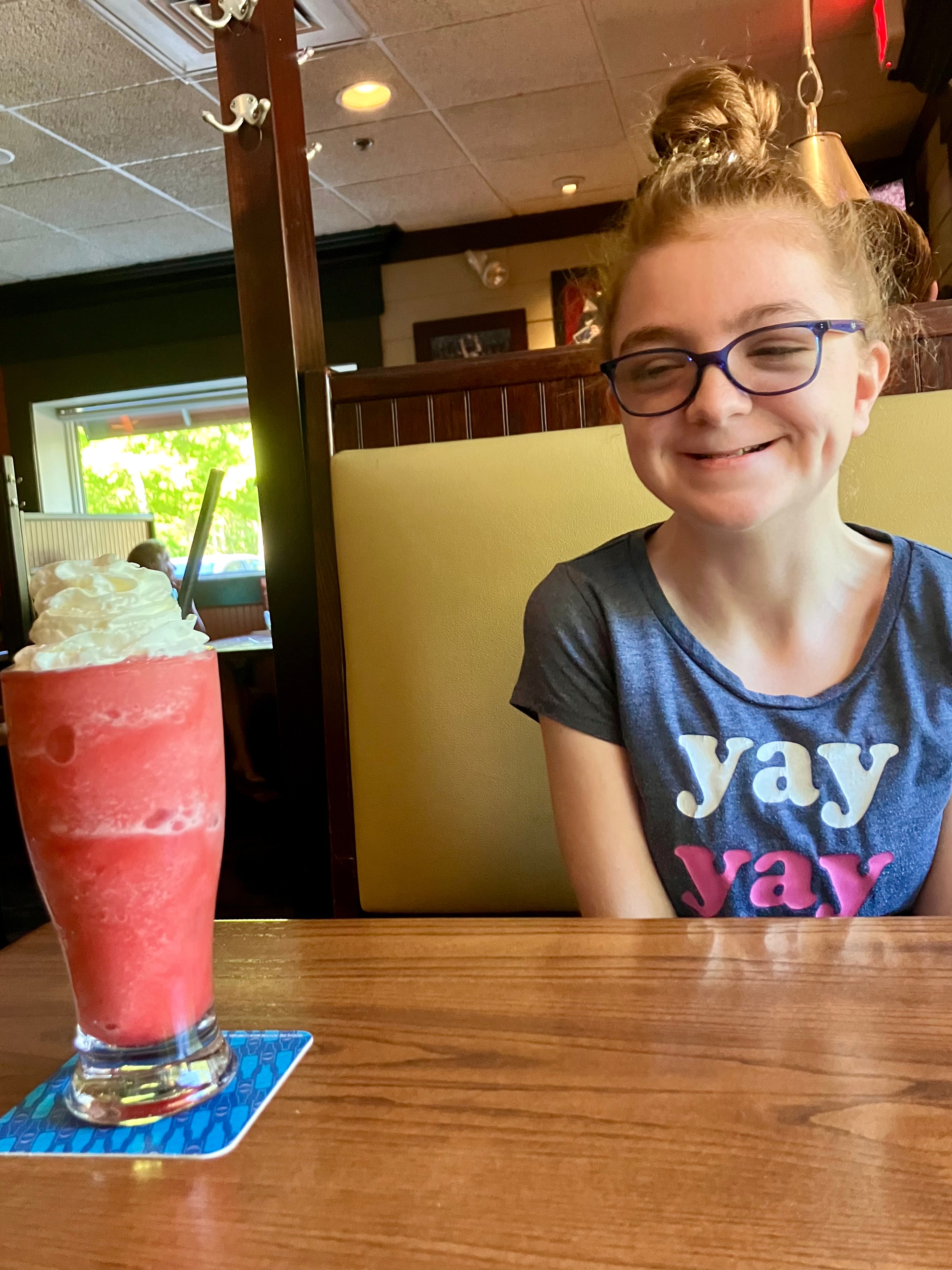
Bridget finds joy in other things, mostly Dunkin Donuts, dinner at the 99, strawberry daiquiris and her IPad.

And that is fine, because in each case both of my daughters are happy. Honestly, I love the 99 so that isn’t a hardship.

In moments like these, where I am remembering where Abby was at 12yrs old and how she is now in her 20’s living her very best life that it is so very different than her sister’s will ever be. That she got to not only graduate high school but choose to go to a college so far away that I have to wonder why she chose to leave the sandbar for the iceberg.

There are days where it is so much easier with Bridget, if I am being honest. Unlike with her sister at 16, there is definite teenage odor, but there is no eye roll. My car insurance has not gone up, since Bridget isn’t getting her permit. I won’t have to pay for college or worry about prom night.

But there are days, like when I go down memory lane, that I wish for just a moment that I had to worry about Bridget getting into the college of her choice

The Parenting Network

One of the things I am most thankful for in this unexpected life is the parents that are willing to share their stories, their IEPs, their tricks, knowledge and experiences. That is part of why I continue to write this blog. Even if it embarrasses my eldest and I’ve been told that “no one blogs anymore.”

Without this blog I never would have found the doctor who after an almost 6-year search, was able to diagnose Bridget with PACS1. Without ingenious therapists who were open to me saying, “a reader told me about this” and trying every therapy possible, Bridget may never have ridden the big yellow school bus.

This is why it is so important that we share our institutional knowledge about this unexpected journey. Just as when parents would share their IEPs in the therapy waiting room, now we are sharing what happens to our adult children as we begin to experience a whole new level of learning.

I always “knew” that before Bridget’s 18th birthday we will have to file for guardianship of her. What I recently learned, thanks to that parenting network, is that there are different types of guardianship and each type has different ramifications.

Mistakenly, I always thought guardianship was kept the status quo. That it was, while legally binding, a foolish piece of paper that just allowed us to keep being Bridget’s caregivers. I did not even realize there are types of guardianship and the implications each one represents.

**Warning I am not a legal professional; this is just information as I have understood/internalized it. If you have a better understanding of this very complicated issue, please let me know! ***

There is the typical guardianship, where I will be appointed ruler of all things Bridget. I will be responsible for her finances, health care, where she will live and every decision big and small. Bridget will technically have no input or ability to counter my decisions. Here is the wrinkle I just learned. Bridget will never be allowed to marry, without Court approval. Now, that is not even something on my radar. Yet I know that a lot of parents hope for this, that their child does have the mental capacity to fall in love.

I recently learned there is another type of guardianship where the parent works with their child in making decisions. Decisions are made to foster independence (which of course, the full guardian wants as well). From my readings, it offers Bridget the choices and input in the decisions her dad and I may make for her. More importantly, she is the driver rather than the passenger. She has the ultimate decision-making power; be it get married or have a procedure. While I am still learning about this type of guardianship, what I know is that for us this is not going to be an option. And not just because I am a control freak.

We also have to consider that we are aging, and most likely Bridget will outlive us. We had to really think about who will care for her in our absence. Her sister has always known that she will one day care for Bridget. Yet we don’t want Abbey to stop living her best life, traveling the world and in her era of saying “yes” to the next adventure.

Until Bridget is 22 years old, she cannot move out of our town, or she jeopardizes her school placement, something else I just learned through the parenting network. Whomever becomes her guardian, must relocate their entire lives to accommodate her needs.

Not only do Bridget’s next caregivers have to rearrange their lives, they have to learn not only all things Bridget but all things in relation to caring for a forever 4-year-old.

My hope is that this fantastic parenting network we have found continues to offer a guiding light to not just to us but to everyone in Bridget’s village.

A little self-care goes a long way

I am horrible at self-care.

With my eldest away at college, I am very aware of how much I took advantage of her being here. Wait, that sounds bad. I did not really take advantage, more I was spoiled by her willingness to hang out with Bridget while I went for a walk, a night out or even just running to the grocery store without Bridget tagging along.

I am extraordinarily lucky that while my friend’s children are grown and have either left the nest or are fully independent, my friends understand that 99% of the time, if they see me that I will have Bridget with me.

I am also lucky that while her dad is as joined at my hip as Bridget is, he does get that once in a while I need a mommy-time-out.

It is my own fault that I have self-isolated…which brings me to how I have also neglected my own self-care. Not just by putting family and work first. Not by not prioritizing myself. But I think I might have had a little (gasp) depression over the past year. Those who know me, know I just threw up in my mouth a little bit by not only writing it out but acknowledging I may not always be able to pick myself up by my big girl panties and suck it the fuck up.

If not depressed, I definitely allowed myself to get “old” over the past year. I’ve gained weight. I am not maintaining my nutrition and balancing the snacks like a 50+ woman should. Instead, I am acting still maintaining the diet of my 16-year-old self with access to my parent’s liquor cabinet! I have not truly exercised (other than walks that become shorter and shorter) this past year. Me, the woman in her 40’s that was running obstacle races probably could not jump rope in her 50’s.

Somewhere along the way, I decided my gray hair was fine. That it was natural. After all, I haven’t worn makeup since it was forced upon me at my wedding 29 years ago. I have historically been a woman that is low maintenance, just some wet hair and some hair gel and I am ready to go. I even started cutting my own hair over the last year (something those of us with curls can get away with!).

Then I saw this photo of me.

Holy crap, I got old.

And not in a graceful, Betty White way.

So the other night, I took some time for some long overdue self-care. I went to an adult salon, not a chain.

Thankfully the stylist not only took mercy on me but guided me away from looking like Elvira and inadvertently signing up to a hair commitment I could never keep. Three hours later I went from this to that.

Photo courtesy of Michelle @ Color Me Crazy Hair Salon

Thank you, Michelle at Color Me Crazy for rejuvenating this tired, overworked special needs mom. It was just what I needed.

The same…yet so different

We are at a strange time. A time when most of Bridget’s typical peers are doing typical things. It is some days difficult to see my friend’s social media posts about their children, balanced by how happy I am for their child’s accomplishments.

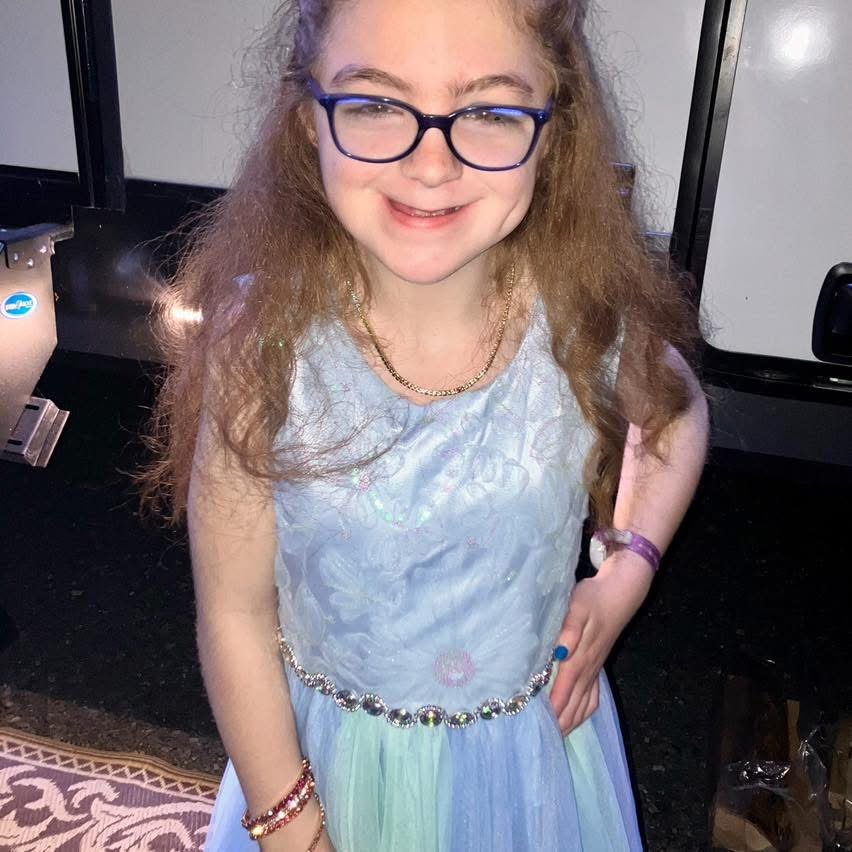
Homecoming, for instance. My friend’s daughters are gearing up for homecoming, with dress decisions, boy decisions, deciding what events to go to. Bridget’s homecoming was a walk around her school and a bounce house. There might be a homecoming dance, but she will not get asked by a boy. She will not drive with friends or be dropped off by a parent. My friend’s daughters will get dressed and do their glam together. There will be laughter and oh my gosh moments. A typical father will wrestle with his little girl in a too short dress going to an unsupervised dance with a boy he thinks he could probably still arm wrestle, but not for much longer. A special needs father will dance with his daughter and make sure no one asks his little girl to dance.

The typical parent and the special needs parent will repeat this process in the Spring during Prom season.

The same, homecoming. But yet so different.

In our area, in Junior High students can begin making choices for where they will spend their high school years. This is usually when a special needs parent makes the most difficult choice between inclusion or a dedicated special needs school. For the typical student there is a process. Do they meet X criteria? Did they win the lottery for the most desired school in the district? For the special needs student it is a similar, but more convoluted process. First, unlike the typical student who can do school choice the special needs child needs permission to even begin looking at alternatives. Once the district is in agreement, the district not the parent has the ultimate decision on where this child will attend school. The schools that are dedicated to special needs also have criteria before even interviewing the student. They look at medical records (are they too fragile?). They look at IEP accommodations and how independent they are. They look at academic testing and IQ results. Yes, believe it or not in the special needs school there are IQ thresholds that may determine where this child can even apply. Each parent, the special needs one and the typical one will go through moments of heart-crushing disappointment and hope to have that moment of YES this is where my child will succeed.

Then the process is repeated, for the typical parent at graduation and the special needs parent when their child ages out of the school system the day before their 22nd birthday.

The same, yet different.

The typical teenager will get their first job. The special needs teen will work vocationally within their school day.

The typical teenager will play school sports. The special needs teen will participate in Special Olympics.

The same, yet different.

From there, as these teens age, the difference between that typical child and special needs child becomes greater.

The typical child will get their driver’s license. The special needs child will ride in the front seat.

The typical child will go into the workforce, the military or higher education. The special needs child will remain in their high school building.

The typical child leaves the nest. The special needs child will not.

Both children will be celebrated for their success and supported in their missteps.

The same, but just in different ways.

Keeping Score

One of the most difficult things I am learning in this time of Bridget’s life is discerning what is behavioral versus what aspects of this newest disease is a mental health issue. Looking back (because it is always easier to see what I did wrong than to predict future mistakes), Catatonia began infiltrating our lives last summer.

As with all things Bridget-itis, the small things I either missed or decided were not important or they were becoming a part of her quirky and cute nature. What I thought was behaviors over time became the tools Catatonia used to try to keep my girl in her head and take her out of our world.

Read more: Keeping Score

Bridget started refusing to leave the house. Going to the grocery store (one of her favorite places) became a negotiation if there wasn’t someone to stay in the car with her. Thinking it was behavioral, I made her push through when there was no other option. I didn’t realize she was having anxiety, and it was mentally painful for her to walk through those doors. Score 1 to Catatonia.

Bridget started talking only to me at home. I thought (at first) it was funny that she would “hide” her face from her dad and whisper to me the answer to whatever he was asking. Instead of being a new behavior, she was having mental anxiety that led to select mutism. Score 2 to Catatonia.

Bridget, while camping, refused to come to the campfire. Spent most of her time not only in the camper, but in her bunk. Bad mom moment, I kind of enjoyed the peace and quiet of camping, reading my book by the fire not having to listen to freaking Doc McStuffins on repeat. Instead, Bridget was showing the first signs of depression. Score 3 to Catatonia.

I asked the Doctor about all of these new diagnoses. If developmentally, Bridget’s brain is 4 years old, what the freak does she have to be depressed or anxious about? Okay, honestly there was a different “f” word in there.

Instead of reprimanding my use of adult language (perks of talking to her psychologist, they’re probably used to much worse), he gently explained that while Bridget’s mind might be 4 years-old, her body is not. Not only is her brain continuing to adapt and fight PACS1, but it is also having to deal with all the other hormonal, body and insert your teenage angst issue here concerns. Since her brain does not know how to deal with all that onslaught, it retreated into a state of catatonia.

Taking a minute here to remind all of you that I am not a doctor and may have misunderstood or misinterpreted all the information the Doctors have thrown at us over the past 4 months. If you have any of these issues or concerns, don’t trust me. Seek medical advice from a medical professional.

Carrying on after that short PSA. The Doctor tried to explain to me that with catatonia, depression, anxiety, select mutism and PACS1 (plus every other diagnosis Bridget has) what I am / have been afraid were behaviors I needed to help her correct, where actual mental health issues that we need to treat.

I asked how to I make sure that I don’t inadvertently create a behavior during this time?

I totally stumped the medical team with that one!

Here is the dilemma, the medical team is treating Bridget the patient. They are treating all the symptoms associated with her new diseases. They are also trying to be caring and cognizant of how her illnesses now affect our lives. (FYI getting up at 6am every day to give her a med SUCKS in JC CAPS, especially on the weekends). Yet they never thought of what behaviors we might create while treating her medical issues.

For example, what if I let Bridget not participate in grocery shopping now, while she is in crisis. What happens when she is no longer in crisis but has a learned behavior of staying in the car with dad? I guess that is okay, if he is home. But what if he is not and I have to run to the pharmacy?

What happens if we isolate ourselves now, to protect her from all her illnesses but that leads to us never leaving the house? (Self-serving PSA–if I am stuck in this house for more than 3 days, not allowed to leave, send Pinot Grigio).

Thankfully, this new cohort of Doctors listen and care. The advice is that if a behavior is not impacting Bridget’s life (like her increased stimming) then it is not a problem. For me not to sweat the small stuff (they are obviously new to the team). The behaviors that do impact her life (not leaving the house) is something we need to focus on. First with medication, then when she is no longer in this crisis “flight” mode, with therapy and baby steps.

And we have begun seeing small wins. Last weekend, Bridget walked to the beach. Score 1 to Bridget.

Today she got off the van very upset because her favorite teacher was not in school today. She verbalized it, and let me hold her until the tears were dry. Score 2 to Bridget

Keeping score, right now catatonia is up 3-2.

I know with time Bridget is going to kick catatonia’s ass. I am just going to have to be vigilant that once she does, there is not another behavior she has to overcome.

If I was a betting person, I would bet on my girl. She has never let me down before.