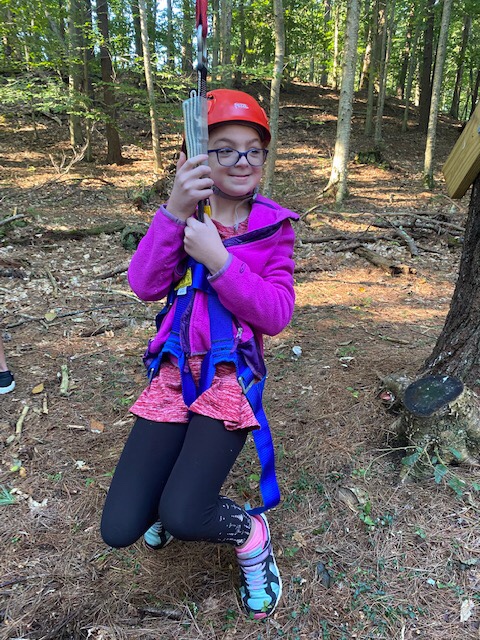
Just about a year ago, we entered the most difficult summer/fall/winter of Bridget’s life. I won’t say it was the most difficult year.
2025
First, I am not tempting the universe with a hey Kerri you thought that was a hard year? Hold onto your Pinot Grigio.
Second, in the spirit of the waiting room game, there have been a lot of difficult years and moments with Bridget.
The first year that started with a NICU and ended with more time spent in the hospital than at home or work. The first year of her life where she began this journey with more doctors than I knew existed. Where I learned new terminology like laryngomalacia and how using Dr Google when I read her medical reports was a REALLY (JC caps) bad idea.
When my husband came home and (rightfully so) told me our life cannot be about this child. That we, as a couple, would not survive if we did not have a life beside hers. The moment when I needed to hear it (though kind of resented it since I was covered in throw-up at the time). But we listened to one another and have not just survived the past 17 years but are still best friends.
The moment when she threw up all over Frecky’s new kitchen. Her brand new kitchen and dining table. And we were not asked to leave.
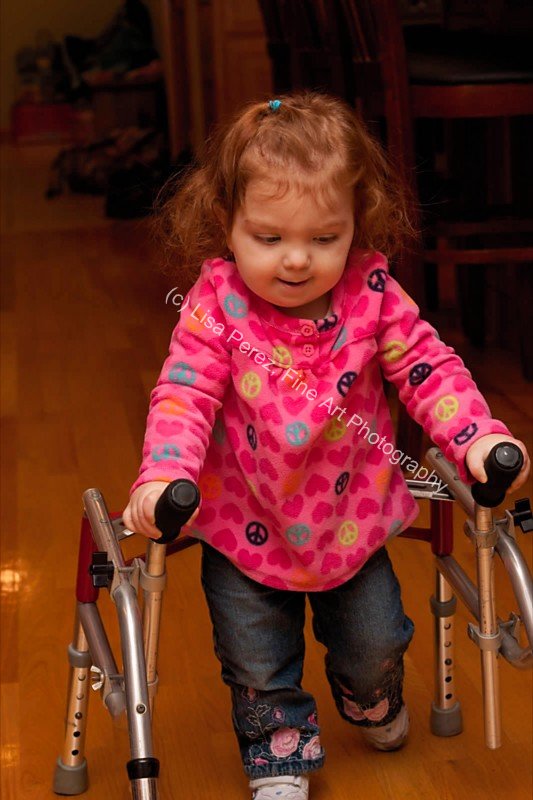
There was the year that I thought I have this, I get this, our child is just behind and learned that there was this thing called an IEP. That my child was not just behind her peers but would never ever be like them. The year that she learned to walk and then the minute she was off her walker, she needed spinal surgery.
The moment when she finally said her first word that everyone understood….and it was HOOKER as she sang along to Grease.
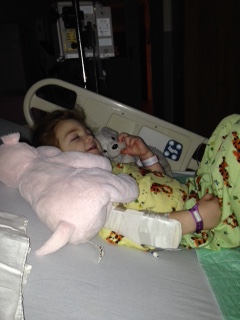
The year that all Abbey wanted for Christmas was her sister coming home, once again from the hospital when we almost lost her to sepsis. That wish coming true on Christmas Eve. In her words, “the best gift ever”
There was also that moment when a friend invited her to a birthday party, where she was not only accepted but a part of the group.
There was the year when I thought her heart was perfect, but she had to have a cardiac intervention. That moment when I realized I was the OG of BCH.
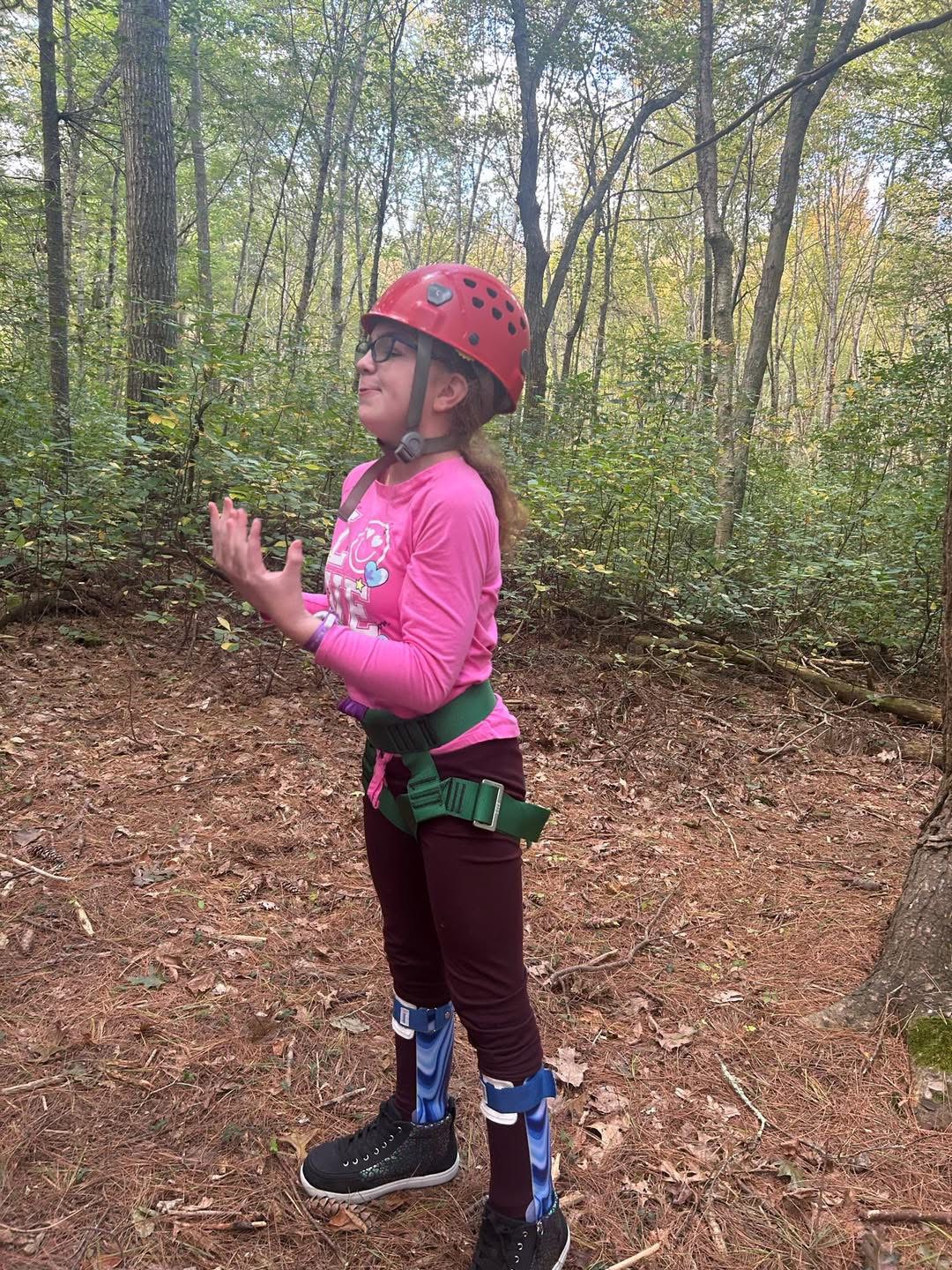
There was the year of accepting the autism diagnosis, learning what the freak AFOs were, the tears at those dreaded IEP meetings. Let’s not even talk about the COVID years where when the schools finally reopened I realized that her peers had moved on and the school I loved could not give Bridget what she needed. Putting her on that van, where she was going to a place I knew no one and had no village. That was a hard moment.
But also the moment of realizing this is where she belongs. That it is more about her happiness than my own comfortably.
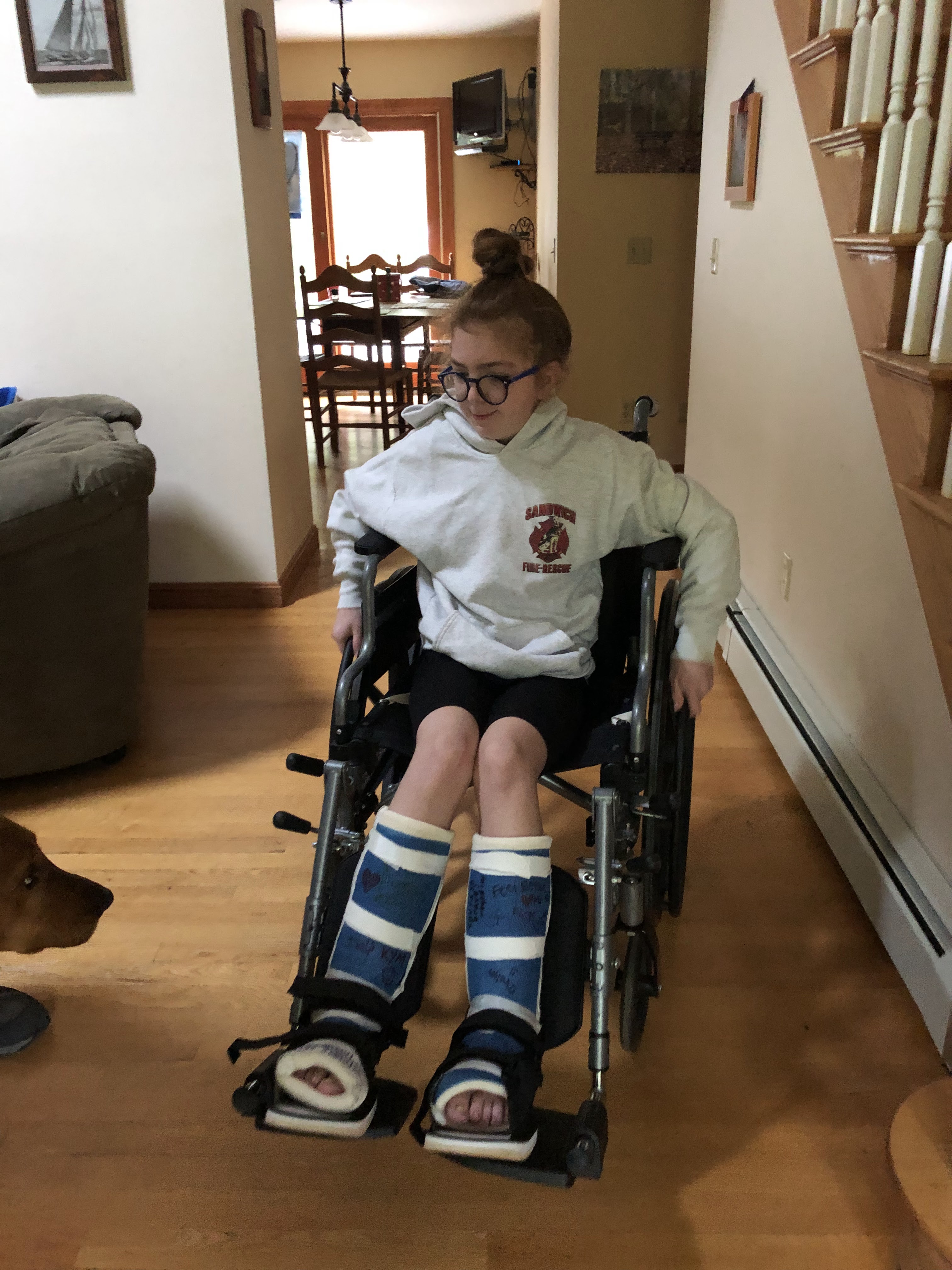
Then that time when she once again needed surgery, this time on relegating her to a wheelchair for months and relearning (once again) how to walk.
A few years of respite, those moments when I mistakenly thought that the universe would give my girl a break. Only for her to become catatonic. When she would beat me, tell me she hates me, cry (both of us) for not apparent reason.
The moment, when we left a party and I angry/ugly cried to Jenn-Said even though she was without sleep and dealing with her own shit. The moments where friends did not let me down, but were once again there for me. That, I swear, put dates on a calendar to make sure I survived last year.
See, before 2025, all those hard times were moments. Yes, each moment broke me a bit. Anyone who regularly reads this blog knows all the times I’ve lost my shit. When I thought I cannot do this anymore. Friends, my freaking village, has held me strong throughout each moment.
But last year, I honestly thought I wasn’t going to survive it. When my beautiful child would hit and scream at me. When I second guesses her medical team. When I thought I did this to her, she was fine retreating from me but I would not let her. When I gave up wine, because it made me whiny (that sucked!).
When I screamed at the universe to just give us a fucking break because she had already endured and triumphed over so many obstacles. That, as parents, we accepted she was never going to prom, get a job, her license or have a life like her sister. And we have finally become okay with the fact that we have a forever 4yo. So give me a freaking break and not give her catatonia on top of every fucking thing PACS1 has made her fight against.
It was a very long nine months. Then, in March 2026, the medicine regimen began to work. My funny girl was coming back. She no longer said I hate you as she hugged me. She no longer threw a temper fit at a retirement party.
She stopped telling Souke that she didn’t want Pop-Tarts and instead started demanding them.
She began interacting with the world again. Telling stories and being the funny comedian. She worked her ass off to become a part of our world again.
So I won’t say that this was the hardest year of her life.
I will definitely say it was the longest moment we have had to survive.
Thanks to her and my villages, we survived.
From the bottom of my heart, thank you to everyone who made this year survivable.
I could not have done it without you.
Let’s just hope the universe forgets about us for a while.
But I know if the universe does not and decides to throw us another PACS1 freaking moment, we will survive it.
One of the most difficult things I am learning in this time of Bridget’s life is discerning what is behavioral versus what aspects of this newest disease is a mental health issue. Looking back (because it is always easier to see what I did wrong than to predict future mistakes), Catatonia began infiltrating our lives last summer.
As with all things Bridget-itis, the small things I either missed or decided were not important or they were becoming a part of her quirky and cute nature. What I thought was behaviors over time became the tools Catatonia used to try to keep my girl in her head and take her out of our world.
Bridget started refusing to leave the house. Going to the grocery store (one of her favorite places) became a negotiation if there wasn’t someone to stay in the car with her. Thinking it was behavioral, I made her push through when there was no other option. I didn’t realize she was having anxiety, and it was mentally painful for her to walk through those doors. Score 1 to Catatonia.
Bridget started talking only to me at home. I thought (at first) it was funny that she would “hide” her face from her dad and whisper to me the answer to whatever he was asking. Instead of being a new behavior, she was having mental anxiety that led to select mutism. Score 2 to Catatonia.
Bridget, while camping, refused to come to the campfire. Spent most of her time not only in the camper, but in her bunk. Bad mom moment, I kind of enjoyed the peace and quiet of camping, reading my book by the fire not having to listen to freaking Doc McStuffins on repeat. Instead, Bridget was showing the first signs of depression. Score 3 to Catatonia.
I asked the Doctor about all of these new diagnoses. If developmentally, Bridget’s brain is 4 years old, what the freak does she have to be depressed or anxious about? Okay, honestly there was a different “f” word in there.
Instead of reprimanding my use of adult language (perks of talking to her psychologist, they’re probably used to much worse), he gently explained that while Bridget’s mind might be 4 years-old, her body is not. Not only is her brain continuing to adapt and fight PACS1, but it is also having to deal with all the other hormonal, body and insert your teenage angst issue here concerns. Since her brain does not know how to deal with all that onslaught, it retreated into a state of catatonia.
Taking a minute here to remind all of you that I am not a doctor and may have misunderstood or misinterpreted all the information the Doctors have thrown at us over the past 4 months. If you have any of these issues or concerns, don’t trust me. Seek medical advice from a medical professional.
Carrying on after that short PSA. The Doctor tried to explain to me that with catatonia, depression, anxiety, select mutism and PACS1 (plus every other diagnosis Bridget has) what I am / have been afraid were behaviors I needed to help her correct, where actual mental health issues that we need to treat.
I asked how to I make sure that I don’t inadvertently create a behavior during this time?
I totally stumped the medical team with that one!
Here is the dilemma, the medical team is treating Bridget the patient. They are treating all the symptoms associated with her new diseases. They are also trying to be caring and cognizant of how her illnesses now affect our lives. (FYI getting up at 6am every day to give her a med SUCKS in JC CAPS, especially on the weekends). Yet they never thought of what behaviors we might create while treating her medical issues.
For example, what if I let Bridget not participate in grocery shopping now, while she is in crisis. What happens when she is no longer in crisis but has a learned behavior of staying in the car with dad? I guess that is okay, if he is home. But what if he is not and I have to run to the pharmacy?
What happens if we isolate ourselves now, to protect her from all her illnesses but that leads to us never leaving the house? (Self-serving PSA–if I am stuck in this house for more than 3 days, not allowed to leave, send Pinot Grigio).
Thankfully, this new cohort of Doctors listen and care. The advice is that if a behavior is not impacting Bridget’s life (like her increased stimming) then it is not a problem. For me not to sweat the small stuff (they are obviously new to the team). The behaviors that do impact her life (not leaving the house) is something we need to focus on. First with medication, then when she is no longer in this crisis “flight” mode, with therapy and baby steps.
And we have begun seeing small wins. Last weekend, Bridget walked to the beach. Score 1 to Bridget.
Today she got off the van very upset because her favorite teacher was not in school today. She verbalized it, and let me hold her until the tears were dry. Score 2 to Bridget
Keeping score, right now catatonia is up 3-2.
I know with time Bridget is going to kick catatonia’s ass. I am just going to have to be vigilant that once she does, there is not another behavior she has to overcome.
If I was a betting person, I would bet on my girl. She has never let me down before.
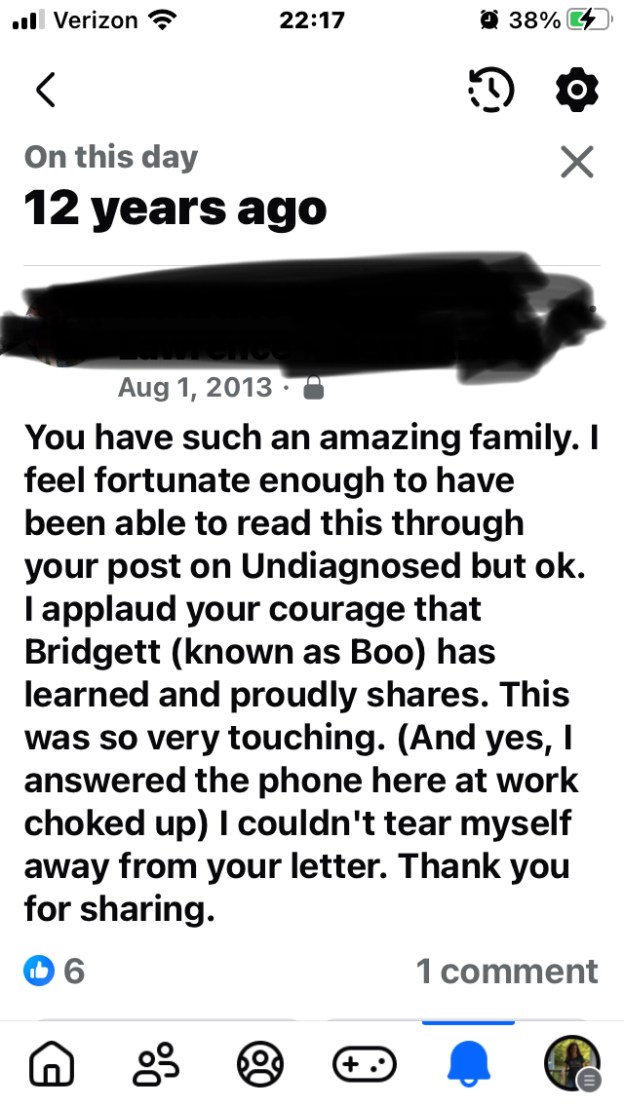
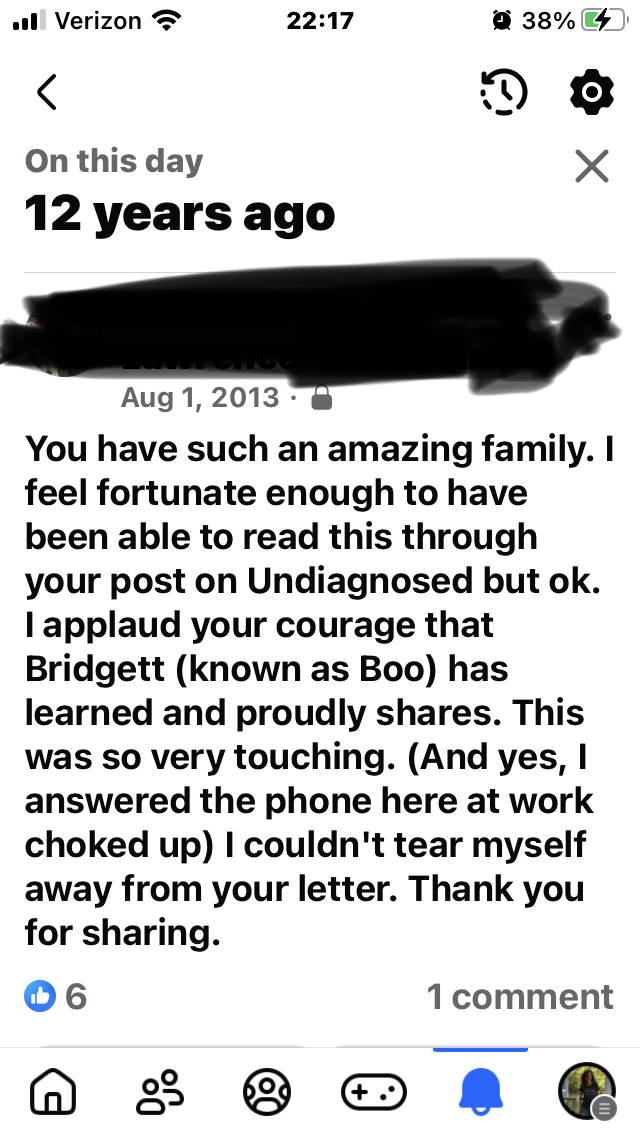
Last week this memory popped up on my Facebook feed and I had no idea what I had written way back in 2013.
I searched and found this post where I was trying to explain to a four-year-old Bridget (Boo back then) why she had to work so hard to make the tiniest progress and how sorry I was that I am the one that causes her the pain, procedures and therapies. Yet I never once in those four years, have I regretted one moment of this unexpected life.
Unfortunately, for Bridget, turning 16 was not sweet. It has been nine months of struggle and after a lot of work, acquiring not one but four more diagnoses and adding more doctors to her list of specialists.
Which brings me to this moment, where that letter to Bridget needs to be updated. *Tissue warning ahead.
Today is World Rare Disease Day. A day to celebrate this unique life Bridget and our family live. I was honored to share our journey today with a BlueRock Therapeutics, a Therapeutic company and the researchers who may someday change the lives of families who battle rare syndromes. While BlueRock does not study PACS1, they are making headway in other diseases.
I was drafted into the role of a rare disease advocate after the birth of my daughter, Bridget. Truthfully, I did not know this world existed until 14 years ago.
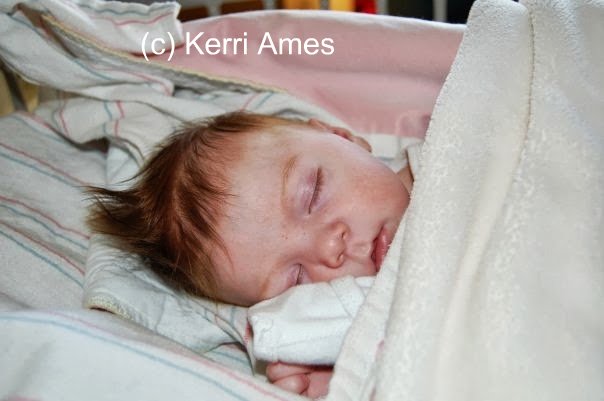
Bridget was born after a normal pregnancy. Shortly after birth, I recall thinking her breathing was funny, like she was scared. We went home, and I recall having Bridget on my knees thinking she was breathing like she was scared. A visiting nurse stopped by a few days later to do a well-check and was concerned by Bridget’s breathing. Thinking back, I honestly was almost cavalier about it. I told her we were taking Bridget to the pediatrician the next week and would mention it to him.
Thankfully the nurse decided to call the pediatrician herself and we were told to drive immediately to Children’s Hospital. This is how relaxed we were, we not only drove to Boston (not calling 911), but we brought her older sister (then 5 years old) and our golden retriever! I had just had a c-section, it was Thanksgiving weekend and thought everyone was overreacting.
I have never been more wrong in my life.
We entered the ER at Childrens and faster than I would have imagined, my 4 day-old baby was hooked up to an EKG machine and oxygen. Around 10pm that night we were told that we would be admitted, my husband left with our older child and I was left not knowing what the heck was happening. At 2 am an ECHO tech arrived and began performing an echo. He immediately called his supervisor and we were transferred to the NICU. Where Bridget gained a lot more doctors and I got a lot more experience at navigating the halls of Children’s Hospital.
After 10 days, Bridget was released home. However this would not be the last time she would visit Hotel Childrens. When Bridget was about 3 months old, we were once again spending a few days at her favorite hospital. A woman walked in and said she was from genetics. She wanted to go over Bridget’s family history. I asked why? Apparently the team was stumped, so they asked Genetics to get involved. None of Bridget’s medical issues correlated to one another. They were hoping to look at genetics to find the answer.
What Genetics found was there was a genetic abnormality, but it came back as “unknown”. Now, imagine as a parent you are told that not only does your daughter have more health issues that were decidedly not in the “What to Expect When You’re Expecting” book, but there was something genetically “wrong” with your child. They could not tell us if she would survive, if she would roll over or if she would talk. We knew nothing.
We were undiagnosed, and okay with that.
From that the moment, I termed it Bridgetitis and decided that since we did not know what it was, it would not limit her.
The next few years were spent throwing every type of therapy imaginable at Bridget. Since they could not tell us what her outcomes would be, we would not let anyone tell us what they would not be. We did physical therapy, occupational, speech and hydrotherapy. We were at the therapy center so often that her therapists became our friends. At 3, we enrolled her in the public schools integrated PK and began ABA therapy. While it took time, Bridget eventually began to walk, she jumped and with a lot of time began to talk. Though it would not be until she was 8 years old that she would have true “speech”.
I began blogging about our journey, desperately trying to find someone like me, a parent who had a child with an undiagnosed syndrome. One day I wrote a piece called “Calling Dr. House”. Bridget had 13 doctors but not one of them looked at the whole child. We had GI, that worked on her reflux. We had neurosurgeon that performed an operation on her spine. We had a neurologist and a developmental delay specialists. So many doctors, but no one talked to another. Genetics seemed to be stumped.
A reader of my blog reached out. She knew of a doctor that would perform EXOME sequencing. As I said, we were trying anything, even if the answer was I don’t know, we wanted to try. We reached out to the doctor who was a clinical biochemical geneticist in Georgia who would provide Exome sequencing, for a price. As this was not covered by our health insurance, we really had to deliberate it. Not only would we have the expense of getting to Georgia, we would have to pay the doctor for her time and then pay the lab fees. We also had a 10 year older sister to consider, who would she stay with while we were away? I researched the doctor, making sure she had credentials, references etc… After doing our due-diligence, we made the trek from the Cape to Atlanta. Dr. Kendall did a thorough exam, ruled out some genetic syndromes immediately and then decided that Bridget should be a candidate for Exome sequencing. We did the testing and went home to await the results.
Fast forward three months. I am sitting at my desk at work and Dr. Kendall calls. She has great news, the Exome testing was able to tell us that Bridget not only has a genetic malformation but what that malformation is. Great! What does she have? PACS1 Dr. Kendall replied. What does that mean, I asked. Her reply? I have no idea. It’s only been seen in two boys in the Netherlands. There was one research paper that she could find.
When I think back to this time, I remember thinking how surreal my life has become. I was at work, it was midday and I had just been given news that changed everything, yet changed nothing.
Of course, I immediately read the PACS1 research paper, that was clearly over my knowledge base. However (and this is where all of you come in), within the paper there was a listing of all the researchers. One of them was from America, a scientist at Duke University. I somehow found his contact information (thank you Google!) and emailed him. I explained how Bridget had just been diagnosed with PACS1, was there any more research going on, did he know anything more than the paper. He responded within hours and was beyond kind. Not only was he kind, he was helpful. He immediately put me into contact with another researcher, who in turn put me into contact with the head of the Study, Janneke Schurrs-Hoeijmakers. Janneke let me know that not only was Bridget, not the 3rd child nor was she the only girl in the world. Bridget was actually the 13th child and the 4th girl to have the syndrome.
What I loved about my interaction with the team of scientists, who did not have to respond at all, was the compassion. One of my favorite quotes from the email sent to me by the professor at Duke was, “I do dream of the day when my response to emails such as yours will be to “take two of these pills and see me in the morning”. He understood how not having the answers not only affected Bridget, but the entire family.
Since 2014, when Bridget received her diagnosis there have now been over 250 children identified as having PACS1. Very limited research is continuing on PACS1, when our numbers are so small, it is hard to get scientists interested. We do have one parent funded research that is in its infancy.
What doctors and scientists should realize is that families are the best source of information. We share everything and notice trends within the group. The parents have learned that it is a mutation that affects multi-systems. PACS1 is a mutation of a protein gene that affects all systems, with varying degrees. For example, all PACS1 children look like siblings with their dysmorphic features, thin lips and button noses. All PACS1 children have an intellectual disability, yet some can read and write while others cannot. Less than half of PACS1 children have epilepsy, yet the majority have reflux and eating issues. As more children are tested, our numbers have grown. We now know that there is no early morbidity as a result of PACS1, the oldest “child” is 38 years old.
We do know that it is not hereditary, so we do not have to worry about future grandchildren or nieces and nephews.
In 14 years of living with Bridget, not one of her specialists has asked how we are doing as a family? They do not seem to understand that Bridget is not the only one diagnosed with PACS1, we all are. Nine years after being diagnosed, we are still on a journey. And the journey is not just Bridget’s, her PACS1 diagnosis affects the entire family.
She has a sister that knows one day she will be responsible to care for her. She has parents that cannot leave her alone to go on a date night. PACS1 affects our finances, for example my husband cannot take overtime if it interferes with my own work schedule. Whereas if Bridget was a teen without PACS1 this would not be an issue. Bridget now goes to a school that has a 45 minute commute, thankfully the school helps with transportation. But if we have to pick her up from school due to a cold, for example it’s not like we can just pop in and continue with our day.
Bridget is going to need lifelong care. She has 14 doctors that need to be seen on a 6m to yearly basis. That means time off of work does not mean to go on vacation but to travel to Boston.
There is also a financial burden, when you have a rare disease. Without insurance, some families face bankruptcy.
I shouldn’t have to preface, but every rare disease parent does: We love our child, but not every day is sunshine and unicorns.
It’s not just the financial impact, but the mental.
When you realize you are still showering your 14 year-old or changing their diaper in the morning. When you realize you cannot go to certain events because you would have to bring your teen, who is actually a 4 year-old with you. When at the grocery store, you have to keep your hand on your child so they don’t disappear.
That you and your partner have to work harder at your marriage than your friends, because there are so many stressors that you can become focused on, you sacrifice your marriage.
It affects the siblings. My older daughter has always known that Bridget would one day live with her. We are incredibly lucky, the girls are extremely close and Abbey has never been jealous. However, I know that this is not the case in a lot of homes. When Dad goes with their typical child and the mom stays home with the PACS1 child. Some siblings resent that they cannot have friends over, or in the middle of the school play their PACS1 sibling acts up and the parents have to leave.
Just like my older child, I do not know what the future is for Bridget. In some ways having a rare syndrome is also having a typical life. Since we don’t know how PACS1 will continue to affect Bridget, just like before she was diagnosed, we do not set limits. We try everything, though soccer was an epic failure, swimming was not! She loves to play mini golf and go sailing, but hates basketball.
Patients like Bridget, have a life outside of their diagnosis. They are a part of the community. One of my mantras is that Bridget will be a part of the village, not the crazy aunt that only comes down for family photos. Yes, PACS1 affects her in so many ways. And as I have said, it also affects the whole family.
But PACS1 does not define Bridget, it just makes her rare.