Tag Archives: special education

The little hits

I have always admired my PACS1 friends that have twins. I feel like it was easier for me, especially when the girls were younger, to have 5 years between them. When my eldest was out of the princess phase, it never bothered me that Bridget was not entering it. I have always wondered how those with twins, that had a front row seat to the differences within their children coped.

In my case, having five years between my girls has always made it easier. First, I had a built-in nanny (until she abandoned me to be all adult like and got to college HAHA). Second, at any age, I could reason with the eldest. No, I cannot do X because I am dealing with Y. Thankfully my eldest was never jealous but instead had tremendous empathy for her sister.

Then last weekend I was cleaning out the girls’ rooms. Bridget had not so secretly moved into her sister’s room. I decided to make her old room into a true guest room and began organizing her sister’s things. Trying to determine what I wanted to keep for memories, what she might want, what were things to pass on and what was truly trash-worthy.

Then I came across this, and my heart broke a little.

It made me realize that I would never have this with Bridget.

Bridget’s bedroom is just that, a room with a bed in it. A place she sleeps. A place that is not filled with glitter (okay, thank God for that!), dolls or imagination. Bridget has never played; her sister would play independently for hours. Abby had such a vivid imagination, a sense of play and creativity.

Bridget finds joy in other things, mostly Dunkin Donuts, dinner at the 99, strawberry daiquiris and her IPad.

And that is fine, because in each case both of my daughters are happy. Honestly, I love the 99 so that isn’t a hardship.
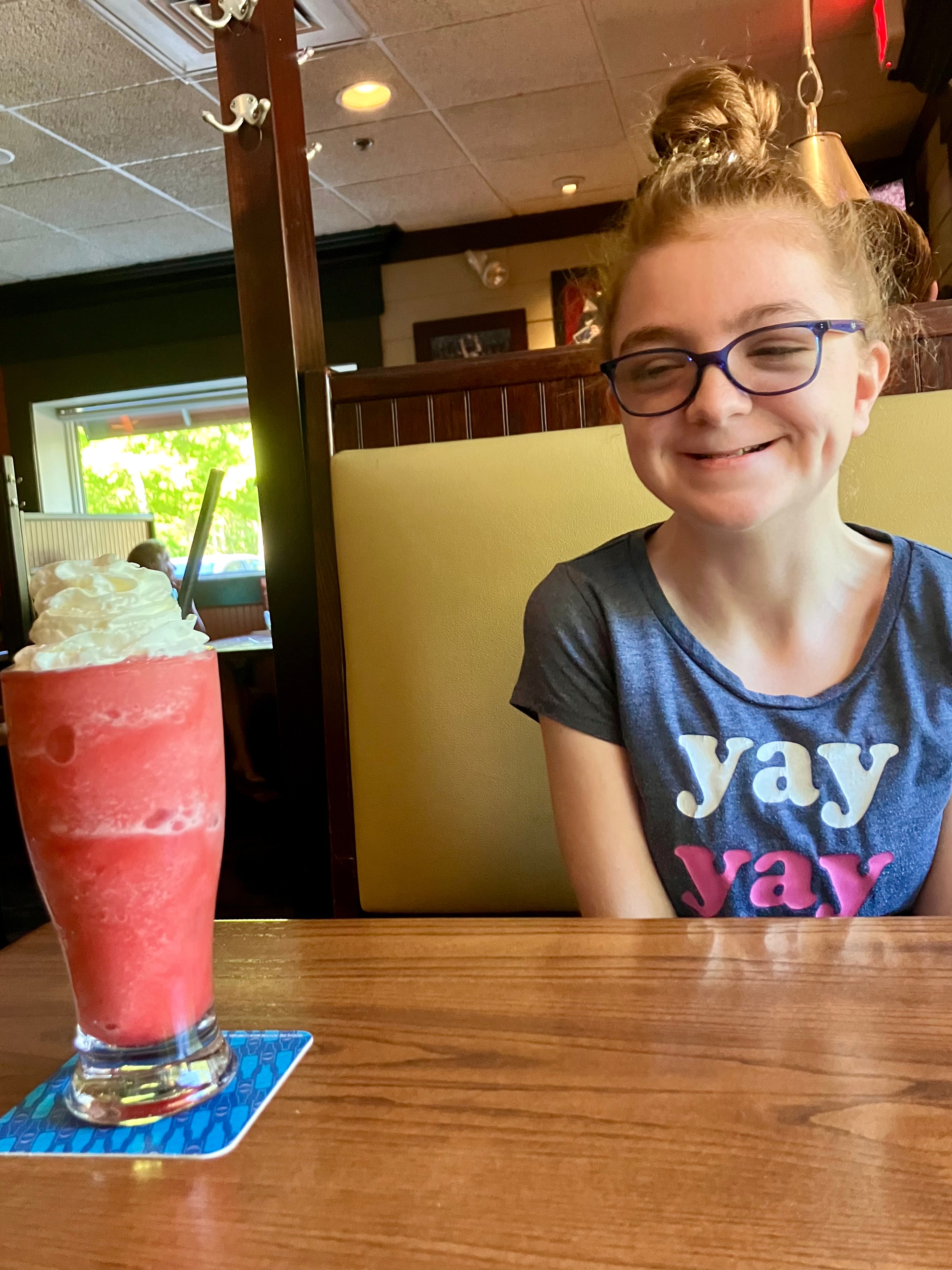
In moments like these, where I am remembering where Abby was at 12yrs old and how she is now in her 20’s living her very best life that it is so very different than her sister’s will ever be. That she got to not only graduate high school but choose to go to a college so far away that I have to wonder why she chose to leave the sandbar for the iceberg.

There are days where it is so much easier with Bridget, if I am being honest. Unlike with her sister at 16, there is definite teenage odor, but there is no eye roll. My car insurance has not gone up, since Bridget isn’t getting her permit. I won’t have to pay for college or worry about prom night.

But there are days, like when I go down memory lane, that I wish for just a moment that I had to worry about Bridget getting into the college of her choice
The Parenting Network

One of the things I am most thankful for in this unexpected life is the parents that are willing to share their stories, their IEPs, their tricks, knowledge and experiences. That is part of why I continue to write this blog. Even if it embarrasses my eldest and I’ve been told that “no one blogs anymore.”

Without this blog I never would have found the doctor who after an almost 6-year search, was able to diagnose Bridget with PACS1. Without ingenious therapists who were open to me saying, “a reader told me about this” and trying every therapy possible, Bridget may never have ridden the big yellow school bus.

This is why it is so important that we share our institutional knowledge about this unexpected journey. Just as when parents would share their IEPs in the therapy waiting room, now we are sharing what happens to our adult children as we begin to experience a whole new level of learning.

I always “knew” that before Bridget’s 18th birthday we will have to file for guardianship of her. What I recently learned, thanks to that parenting network, is that there are different types of guardianship and each type has different ramifications.

Mistakenly, I always thought guardianship was kept the status quo. That it was, while legally binding, a foolish piece of paper that just allowed us to keep being Bridget’s caregivers. I did not even realize there are types of guardianship and the implications each one represents.

**Warning I am not a legal professional; this is just information as I have understood/internalized it. If you have a better understanding of this very complicated issue, please let me know! ***

There is the typical guardianship, where I will be appointed ruler of all things Bridget. I will be responsible for her finances, health care, where she will live and every decision big and small. Bridget will technically have no input or ability to counter my decisions. Here is the wrinkle I just learned. Bridget will never be allowed to marry, without Court approval. Now, that is not even something on my radar. Yet I know that a lot of parents hope for this, that their child does have the mental capacity to fall in love.

I recently learned there is another type of guardianship where the parent works with their child in making decisions. Decisions are made to foster independence (which of course, the full guardian wants as well). From my readings, it offers Bridget the choices and input in the decisions her dad and I may make for her. More importantly, she is the driver rather than the passenger. She has the ultimate decision-making power; be it get married or have a procedure. While I am still learning about this type of guardianship, what I know is that for us this is not going to be an option. And not just because I am a control freak.

We also have to consider that we are aging, and most likely Bridget will outlive us. We had to really think about who will care for her in our absence. Her sister has always known that she will one day care for Bridget. Yet we don’t want Abbey to stop living her best life, traveling the world and in her era of saying “yes” to the next adventure.

Until Bridget is 22 years old, she cannot move out of our town, or she jeopardizes her school placement, something else I just learned through the parenting network. Whomever becomes her guardian, must relocate their entire lives to accommodate her needs.

Not only do Bridget’s next caregivers have to rearrange their lives, they have to learn not only all things Bridget but all things in relation to caring for a forever 4-year-old.

My hope is that this fantastic parenting network we have found continues to offer a guiding light to not just to us but to everyone in Bridget’s village.

Sometimes we are not the same

I write and believe there are a lot of times my life as a special needs mom is the same as my role as a typical mom.

While I believe in those times, there are so many times when my neurotypical mom role with my oldest is so divergent as my role as Bridget’s mom

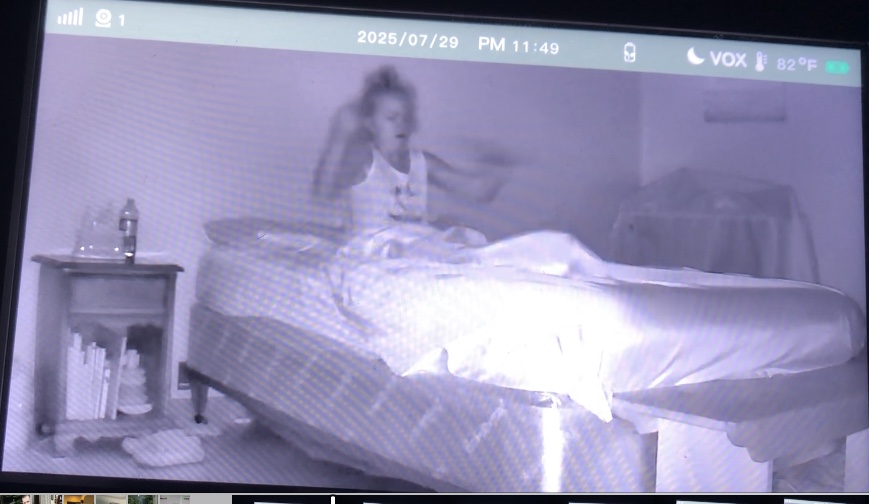
I’m sitting here at 9pm with a baby monitor next to me because I have to watch her for stimming, check in if she needs the bathroom and when the monitor goes off at 1am to make sure she’s not out of bed getting her iPad

Screenshot

Unlike my eldest, I have full control of Bridget’s medical chart and finances

When my eldest was 16y old she got home after school by herself. With Bridget I rush home from work to meet the SPED van that doesn’t call me when two children are out that day so she will be dropped off 30 minutes ahead if schedule

When my eldest was 16 I left her home with Bridget while I was at a work conference in Vegas. For the weekend. I cannot leave Bridget home long enough to go to the grocery store

When my eldest went to college I should’ve been an empty nester. With Bridget that will never be a phase in my life.

This is all okay, honestly. It is okay that Bridget is living a different life than her sister. As much as I like to focus on the similarities, rather than the differences, I also know that it is important to remember that they are different.

Just like all siblings.

It’s IEP Season

For most parents, going back to school means buying new school supplies (another pair of scissors!), fighting with your child over new sneakers and back-to-school clothes.

For the special needs parent, it means that the IEP season is on us and we have to review the current IEP to see what goals our child have attempted to accomplish, which goals were good on paper but an epic fail in reality, what new goals we want to see our child attempt and the parent concern statement.

The dreaded parent concern statement. How does a parent whose child has significant special needs create a “concern statement”. Our child’s entire being is a concern. Yes, we want the IEP to be a guide of how to address the concerns. But in reality, there is no way this piece of paper is going to address them. Even if we concentrate on what the school team needs to focus on, forgetting about every other aspect of our child’s life, there is not enough ink in the world to truly capture a parent’s concern.

I have been incredibly lucky that since Bridget’s first IEP at 3-years old (before I even knew what an IEP was), the IEP team has always been a true team. Collaborating together to create a document to guide the education and progress of Bridget. In the 13 years since, there really have been only two times that I feel I had to go toe-to-toe with the educators to remind them that while we are a team, I am the Captain of Team Bridget.

Looking back, when Bridget was younger the IEP was about trying to catch her up to her peers. As she aged, and the gap became too obvious to ignore the IEP became a document to relocate Bridget from the traditional school system to a specialized school that is more equipped to fulfill her significant needs.

As she gets older, the IEP becomes less about learning how to read and more about how to stay at a task for increments of time so that she may one day work at a vocation. It is about learning how to hand a card with her information on it in the case she gets lost. How to navigate a crosswalk and parking lot safely.

As her parent, my expectations are sometimes not in alignment with her capacity.

This is why each participant on her IEP team is important and must come into the room to collaborate with kindness.

This morning, before the IEP meeting I addressed the team with this intention:

If my expectations for Bridget are too low (like giving up on her learning to read), they need to tell me. If my expectations are too high (like her working at a job), I need to know that to.

I believe that at times the educators and therapists are afraid to tell the parent that while they adore your child, there is a reason they are not in the traditional public school.

As we worked through the IEP, I realized that Bridget has entered a new era in her life. We are working on function over form. We are working on making her safe, helping her communicate more effectively, and how to navigate a vocational site.

Bridget is learning how to use a visual menu at McDonalds and how to use a gift card to get her strawberry milkshake.

There are still academics being taught, but not in the traditional sense. Instead of learning algebra, Bridget is learning how to follow a recipe with visuals. Instead of learning how to read a novel, Bridget is learning how to follow a visual schedule.

I admit to this being a painful realization, but that pain is easier to bear when I remember this was the child that wasn’t supposed to survived.

And thanks to the time and compassion her IEP team being invested over the past 14 years…

Bridget has thrived.

Ten Things

I am a firm believer that the more I recognize the good that has happened this week, the easier it is to deal with a week full of Mondays.

And this week has been a Monday. All freaking week. It wasn’t just me, either. Everyone I talked to, from friends, coworkers, customers and Bridget’s team said their week felt like one long freaking Monday.

Which brings me to the first thing to be grateful for

  1. That others acknowledge bad days. That when I say this has been the longest Monday, and it is Thursday they immediately get me and make me feel less alone.
  2. That my week started with brunch with two of my friends from high school. That we shared, laughed until we cried and shared the hard times. The times that in the grand scheme of things, are less than world hunger but more than noticing the milk has gone sour after your first sip of coffee. That the time went by so fast it wasn’t until we got home that we realized we forgot to take the group selfie. Again.
  3. That I’ve kept this basil plant alive. Those who cannot grow, buy their herbs from the grocery story and the fact that after multiple attempts to grow my own have failed, my Market Basket basil is alive and well.
  4. Wine, because let’s face it life is always better with Pinot Grigio.
  5. When I lost my shit last weekend after Bridget screamed she hated me (while hugging me) my husband didn’t try to fix me. Instead, he held me and said, this really sucks.
  6. That my mom is finally healthy enough to go out to dinner and ate her entire meal.
  7. That my sister-in-law read how I blame her mom for the “mothers curse” post and saw the humor (and agreed with me).
  8. That at Bridget’s IEP this week, her team were kind at keeping my expectations in check and understood my need to make Bridget as independent as possible before she leaves their school.
  9. That I have a village that remember all of Bridget’s appointments and check in to make sure I am okay. That they check in to share their own struggles so that I do not feel like I am always taking from them. That at the brunch on Sunday, they just assumed Bridget would be there and when she was not poured me a really big glass of wine and let me really relax for the first time in too long.
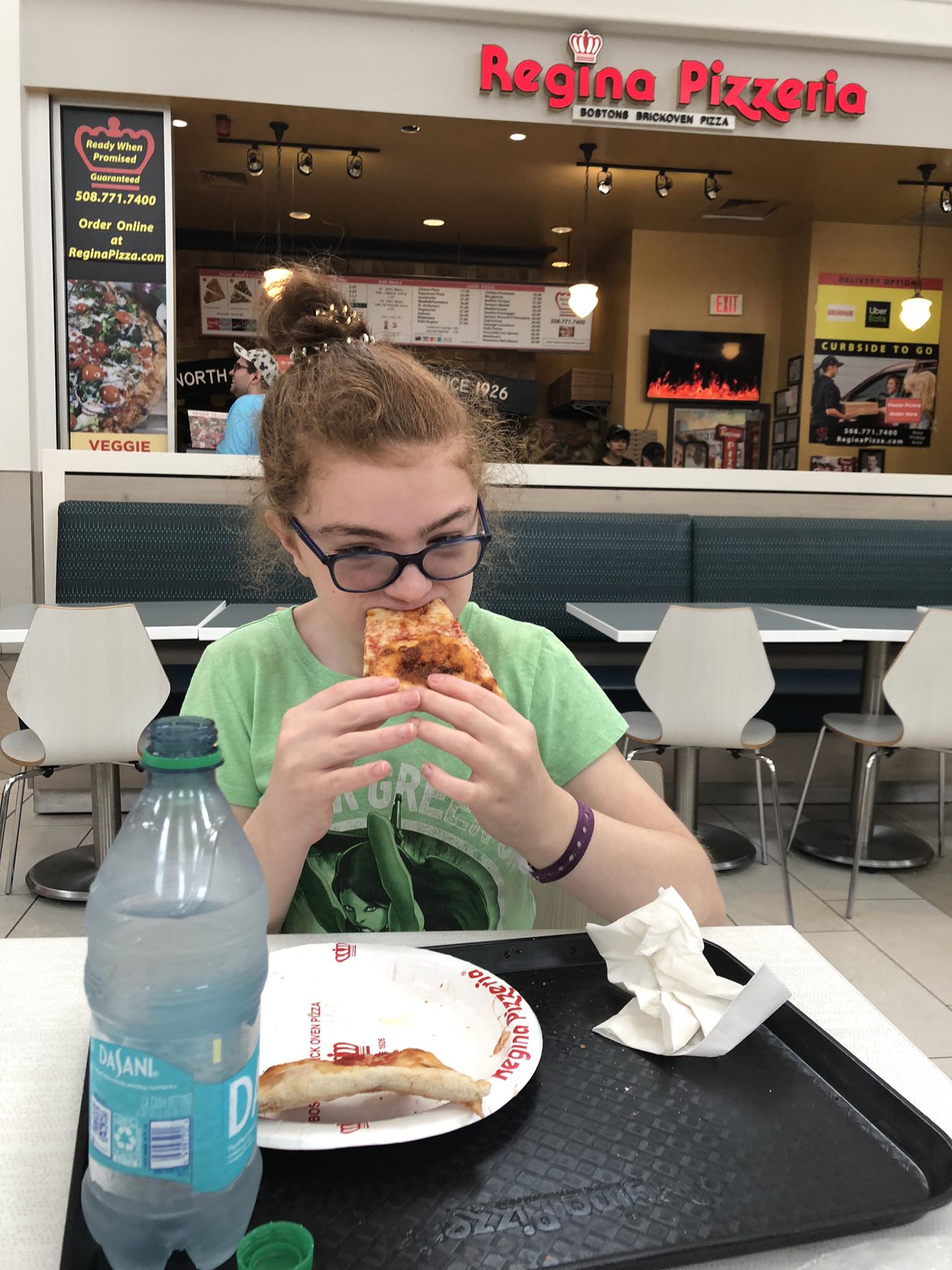
  10. That my week ended with mall pizza with Bridget and another best friend who didn’t care that we were at a food court. She laughed when shoe shopping for Bridget took 2.2 seconds and when we strolled the mall, she engaged with Bridget. Friends that bring Bridget out of her shell and into the world around us is priceless.

A week full of Mondays could leave me crying in my wine. But as hard as this week was? It was also full of more than ten things that brought a lightness to my week. The friends that make this unexpected life so much easier to navigate the speed bumps life keeps putting in our way.

What are you thankful for this week?

Dear Teacher

Dear Teacher (ESP/Therapist),

This is not about how much we know you care about our children. We know you struggle with them (some days) and you never give up on them. It’s about the process in reporting their progress that hurts.  It also doesn’t make sense.

How can a standard report card accurately state how my child (or any child with an intellectual disability) is doing in 4th grade? Continue reading

Rare, but together we are mighty

When your child is diagnosed with a rare syndrome, you are at first overjoyed: YAY! We know what “this” is! Then you are back to being overwhelmed: What do they mean they don’t know what “this” is! A parent who spent years searching continues on, looking for answers, looking for a cure and (most desperately) looking for someone who has been there before who can give you a road map.

I spent the first five years of Bridget’s life without a road map.  Not one doctor could tell me anything other than, we know something is wrong but we don’t know what it she has. Years of seeing doctors and specialists who would tell us that we are doing everything possible to make Bridget the best she could be, and to keep up the good work.

Then we were diagnosed with PACS1.

Journey over, right? Um how about it was just beginning. Continue reading

Third time’s the charm, I hope

I do not consider myself an athlete. I have never pushed Bridget’s older sister to compete, join a team or do anything but follow her passion. I do wish her passion wasn’t horses or adopting every stray animal, but I have been perfectly happy not having to sit on the sidelines at some cold and rainy soccer field.

It is easy, with Bridget, not to worry about typical events in children’s lives.  We have been so busy trying to make Bridget verbal and a member of society, we can forget to expose her to normal, run-of-the-mill life experiences.  Recently her SPED teacher told me that she thinks that parents with children who have disabilities forget to do the normal childhood fun, like sledding or skiing or just playing outside.  I tried to explain that, for me, having faced failure before it makes me less likely to try again.  It is definitely easier to just let her watch her I-Pad then to continue to expose her to experiences that are going to make her cry.  Last year we tried basketball, epic fail. We tried soccer and watched our little girl happier sitting on sidelines than kicking the ball.

Yet, I do not want Bridget to sit on the sidelines of life.  My entire goal with Bridget is to make her a functional member of society. I want her playing with other children, not lost in the world of videos.  Lucky for me our town recreation department is making a concerted effort to work with Special Olympics. For the winter they offered bowling.  We talked it over and felt, well she won’t get knocked over by her teammates, let’s give it a try.

She loved it.  I mean loved it more than Fig Newtons kind of love.  She might win the World Record for slowest bowling ball down an alley, but she had so much fun!

The next day she walked into her first grade class and actually shared what happened during circle time. “I go bowling with J”. Her teacher told me that Bridget’s excitement was beyond measure. Bridget articulated her story and added to the classroom activity.  Bonus, she retained what happened and will tell anyone she comes into contact with how she went bowling.

This is something we can do as a family. Bowling is not only accessible it does not need to be adapted for Bridget to access it. Except the gutter guards, but even I would benefit from that help.

I always want to have Bridget access “typical” experiences.  Special Olympics has taught me that by exposing her to adaptive experiences first she will have much more success.


***********************************************************************
I am incredibly thankful to the Sandwich Recreation Department, their partnership with Massachusetts Special Olympics and for the generosity of Ryan Family Amusements for donating the lane time to let “special” families feel typical for a few hours on a Saturday. 


When First Grade is more

I understand it has only been half a year. However I want to go on record (and brag) that the combination of Bridget’s special education teacher and (epic) first grade teacher is more than I could ever had hoped. The first grade teacher not only understands inclusion, she “gets” that Bridget isn’t the class pet there to give hugs but to be a part of her classroom. Though Bridget’s hugs are a hot commodity. Continue reading

What they really need to learn

Bridget has a fantastic program at her school. While it is not as inclusive as I would like, I will not deny how far she has come this year. Her language? It has exploded to where the need to translate for her.  She can now jump. She can now escape the house. She can also steal a half-moon cookie and eat it for breakfast.

https://youtu.be/jb1SDoQbCzw

Continue reading