Author Archives: firebailey

Unknown's avatar

About firebailey

I possess many titles: wife, mom, advocate, runner, Bruins fan, lover chocolate and Parrot Head. I believe you can conquer any challenge in this world with family, good friends and wine. I write about most of that and more while keeping my sense of humor in this life I never expected.

Ten Things of Thankful

There has been a lot going wrong in our lives this year, but there is so much more going on to be thankful for this week.

  1. That Bridget has a team of Doctors that care about her as a person and are not treating a disease but how that disease impacts every aspect of her life.
  2. That I have a job, a boss and a team at work that understands Bridget has to come first and allows me to work not only a flexible schedule but a remote and sometimes from the PACU schedule.
  3. That there are friends I have not kept in contact with or up to date with Bridget’s recent struggles understand that it is a me not them thing.
  4. That Jenn doesn’t need chemo.
  5. That even though I am a people pleaser and it is incredibly difficult for me to say “no” to an invite, I have become more comfortable with answering: I would love to but Bridget is having a really good day so I am going to stick with our plans for the day. And that my friends and family understand that response.
  6. That I have friends that let me ugly cry, but not wallow in self-pity.
  7. That my eldest is living her best life and while I miss her not coming home this summer, this is how it is supposed to be.
  8. That through this really difficult time, when we have to put Bridget first our marriage isn’t perfect, but it has not imploded.
  9. That when I had to remove Bridget from a retirement party, our friends didn’t judge but were compassionate and understanding
  10. That this happened for the first time in months

Keeping Score

One of the most difficult things I am learning in this time of Bridget’s life is discerning what is behavioral versus what aspects of this newest disease is a mental health issue. Looking back (because it is always easier to see what I did wrong than to predict future mistakes), Catatonia began infiltrating our lives last summer.

As with all things Bridget-itis, the small things I either missed or decided were not important or they were becoming a part of her quirky and cute nature. What I thought was behaviors over time became the tools Catatonia used to try to keep my girl in her head and take her out of our world.

Read more: Keeping Score

Bridget started refusing to leave the house. Going to the grocery store (one of her favorite places) became a negotiation if there wasn’t someone to stay in the car with her. Thinking it was behavioral, I made her push through when there was no other option. I didn’t realize she was having anxiety, and it was mentally painful for her to walk through those doors. Score 1 to Catatonia.

Bridget started talking only to me at home. I thought (at first) it was funny that she would “hide” her face from her dad and whisper to me the answer to whatever he was asking. Instead of being a new behavior, she was having mental anxiety that led to select mutism. Score 2 to Catatonia.

Bridget, while camping, refused to come to the campfire. Spent most of her time not only in the camper, but in her bunk. Bad mom moment, I kind of enjoyed the peace and quiet of camping, reading my book by the fire not having to listen to freaking Doc McStuffins on repeat. Instead, Bridget was showing the first signs of depression. Score 3 to Catatonia.

I asked the Doctor about all of these new diagnoses. If developmentally, Bridget’s brain is 4 years old, what the freak does she have to be depressed or anxious about? Okay, honestly there was a different “f” word in there.

Instead of reprimanding my use of adult language (perks of talking to her psychologist, they’re probably used to much worse), he gently explained that while Bridget’s mind might be 4 years-old, her body is not. Not only is her brain continuing to adapt and fight PACS1, but it is also having to deal with all the other hormonal, body and insert your teenage angst issue here concerns. Since her brain does not know how to deal with all that onslaught, it retreated into a state of catatonia.

Taking a minute here to remind all of you that I am not a doctor and may have misunderstood or misinterpreted all the information the Doctors have thrown at us over the past 4 months. If you have any of these issues or concerns, don’t trust me. Seek medical advice from a medical professional.

Carrying on after that short PSA. The Doctor tried to explain to me that with catatonia, depression, anxiety, select mutism and PACS1 (plus every other diagnosis Bridget has) what I am / have been afraid were behaviors I needed to help her correct, where actual mental health issues that we need to treat.

I asked how to I make sure that I don’t inadvertently create a behavior during this time?

I totally stumped the medical team with that one!

Here is the dilemma, the medical team is treating Bridget the patient. They are treating all the symptoms associated with her new diseases. They are also trying to be caring and cognizant of how her illnesses now affect our lives. (FYI getting up at 6am every day to give her a med SUCKS in JC CAPS, especially on the weekends). Yet they never thought of what behaviors we might create while treating her medical issues.

For example, what if I let Bridget not participate in grocery shopping now, while she is in crisis. What happens when she is no longer in crisis but has a learned behavior of staying in the car with dad? I guess that is okay, if he is home. But what if he is not and I have to run to the pharmacy?

What happens if we isolate ourselves now, to protect her from all her illnesses but that leads to us never leaving the house? (Self-serving PSA–if I am stuck in this house for more than 3 days, not allowed to leave, send Pinot Grigio).

Thankfully, this new cohort of Doctors listen and care. The advice is that if a behavior is not impacting Bridget’s life (like her increased stimming) then it is not a problem. For me not to sweat the small stuff (they are obviously new to the team). The behaviors that do impact her life (not leaving the house) is something we need to focus on. First with medication, then when she is no longer in this crisis “flight” mode, with therapy and baby steps.

And we have begun seeing small wins. Last weekend, Bridget walked to the beach. Score 1 to Bridget.

Today she got off the van very upset because her favorite teacher was not in school today. She verbalized it, and let me hold her until the tears were dry. Score 2 to Bridget

Keeping score, right now catatonia is up 3-2.

I know with time Bridget is going to kick catatonia’s ass. I am just going to have to be vigilant that once she does, there is not another behavior she has to overcome.

If I was a betting person, I would bet on my girl. She has never let me down before.

The Difference Between a Doctor and a doctor

Bridget has outlasted most physicians, therapists and teachers in her short life. With her most recent health struggles, I have begun to observe there is a difference between a Doctor and a doctor.

A doctor sees the diagnosis. A doctor treats the disease, not the patient. A doctor is on a schedule, barely knows your history and rushes through your appointment to the next patient.

Bridget has had a few of those. I call them the “Harvard Docs” who think their degree trumps her will or my momma-warrior gut. The ones that do not take the time to even look at her medical history or when they do they stop at a few years. They treat the body part they specialize in, not the whole child.

There was that one doctor who I will never forgive, who told us Bridget would never.

There is that one neurosurgeon who I had to remind without patients like Bridget, he would not be able to afford that ski vacation depicted in the photos all over his office so he could give me a freaking minute to digest the fact that my 3yo (at the time) would need spinal surgery after just learning to freaking walk. (Okay, 13 years later I should probably let that one go!)

Then there are the Doctors and Nurse Practitioners.

The Doctor/NP truly cares about the patient. Not that they are facing a disease, but how that disease impacts their entire quality of life. The Doctor/NP tells this mom that Bridget has fought too hard to walk, talk and be a part of her community to let PACS1 and catatonia take that from her. The Doctor/NP doesn’t look at behavior and judge your child (or your parenting skills) but does truly investigative work to find out what changes are happening and why.

With Bridget’s most recent diagnosis, I was already overwhelmed and worried does not fully capture the roller coaster of emotions. She now has three new doctors, and this is how I came to realize the true difference.

The new Doctor answers emails within 15 minutes of me sending them, even if it is at 8pm. The new Doctor calls to “check in”. He emails me and will say “our next appointment isn’t for a week, but remember to contact me if you need me before then” or “how did Bridget’s spinal tap go today? Did she have any anxiety going back to the hospital?”

Bridget’s primary-NP sat with us for over 45 minutes to strategize how to help our family through her struggles. She questioned why we did not have a complex care nurse from her practice in contact with us, and the next day arranged a phone call to see what additional support they could help arrange for Bridget. She admits that she does not know enough about this newest diagnosis but starts researching it to be a resource for us.

Bridget’s Doctor of all Doctors, her neurologist never disregarded my concerns, found time in her schedule to see Bridget with just a few days’ notice (anyone who has tried to schedule a Children’s Hospital follow-up knows that you are lucky to get back in within six months. So, to be seen within 3 days is a freaking miracle. Then during her inpatient admission, found us in the MRI suite to make sure we were doing okay. Then this Doctor attends one of Bridget’s appointments with the new specialist to provide not only her insight but her institutional knowledge of all things Bridget. She works with this new team, without ego or compensation.

The Anesthesiologist who never gets repeat patients, remembered Bridget from her Achillies tendon surgery a few years back, then her MRI last month. Last week when Bridget returned for a spinal tap, this Doctor remembered Bridget and that she gets upset as they wheel her out of the pre-op pr post op when they wake her without me. This Doctor not only made sure to talk to Bridget (like a person!) but then turned to her assistant and explained that Bridget needed help to relax before leaving me and what she would need when they begin to wake her.

Then I think back to when Bridget was only 3 years old and her GI Doctor happened to be at a conference and whatever session she was attending made her think of Bridget. We were not scheduled to see her for another 4 months, but she called and told me about this new idea that constipation could be caused by a tethered spinal cord. Thanks to her due diligence, Bridget’s cord issue was found early and not years later when significant damage would have been done.

What I have found, especially after the past few months, is that this world needs more Doctors/NPs and not just doctors who have let the healthcare system change them from idealists to paperwork-driven/cover-my-ass so insurance companies pay driven.

Bridget has been beyond lucky to Doctors and Nurse Practitioners that truly care for her as a person. This team of Specialists that but the person first, the diagnosis second are truly special. They look at the whole child, not the body part they specialize in.

Thankfully these Doctors/NPs outnumber those that have lost the reason why they entered this profession.

If I could ever attend an M&M rounds/Physician seminar this is what I would like to impart:

There are days that work sucks. You are understaffed. You are beholden to the Insurance companies and healthcare system that have monetized your profession. Instead of treating patients, you are working to justify their treatment to someone without your knowledge, education or experience. You are dealing with sick patients and family members that are probably overwhelmed and financially strained. You are working with a class of people at their lowest and most vulnerable times.

You have a choice, heal with compassion or treat with your medical degree.

They both pay the same, but only one will reward you.

For every bad day

After my vent-post the other day, I received so much compassion that is simply overwhelming. As I said to one friend, I am a much better caregiver than caretaker. One person did reply (sweetly) that Bridget and I make this life seem easy. Not in the way people who have perfect Facebook/social media lives, but you know their real life is a hot mess.

In our case, whether you see us online or in the supermarket, we live Bridget’s life out loud. The good, the fun, the ugly cry moments and the ones that bring me to my knees.

The reason I am so open, is that if I can make one parent (or sibling) feel like they are not the only one living this life, that there is one person on this Earth that might not exactly what they are going through, I do know that feeling of what the actual fuck! I know how it feels that we cannot seem to have a “quiet day” but maybe not exactly what brought you to that moment.

We are also so very lucky. For every single bad day (or moment or month) we have 50 really great ones.

This past weekend was full of those little great moments that make it easier to get through the really tough days. I know they are little moments, and the bad moments have felt insurmountable lately. But for me, these moments allow me to remember the girl who would never…

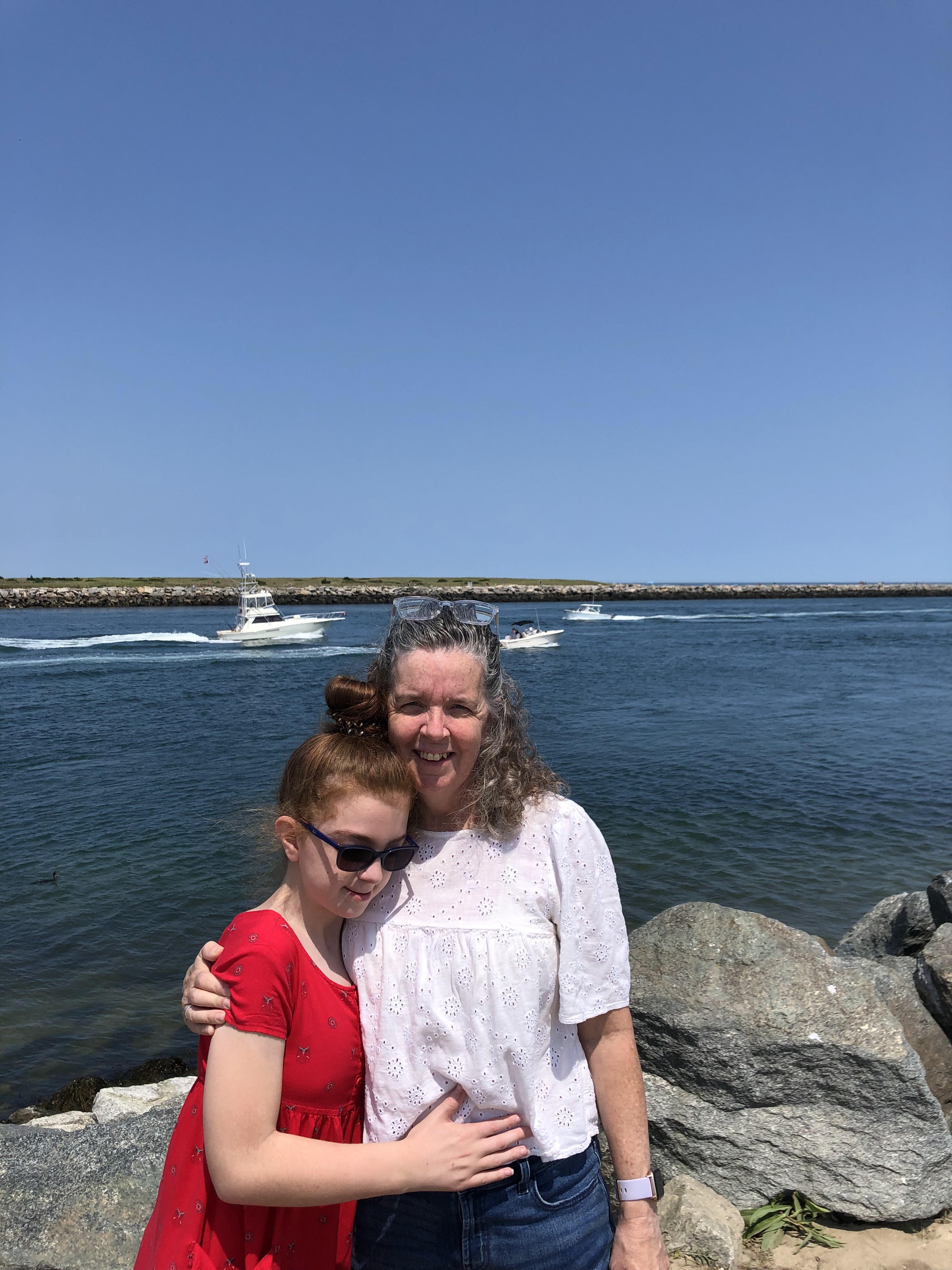
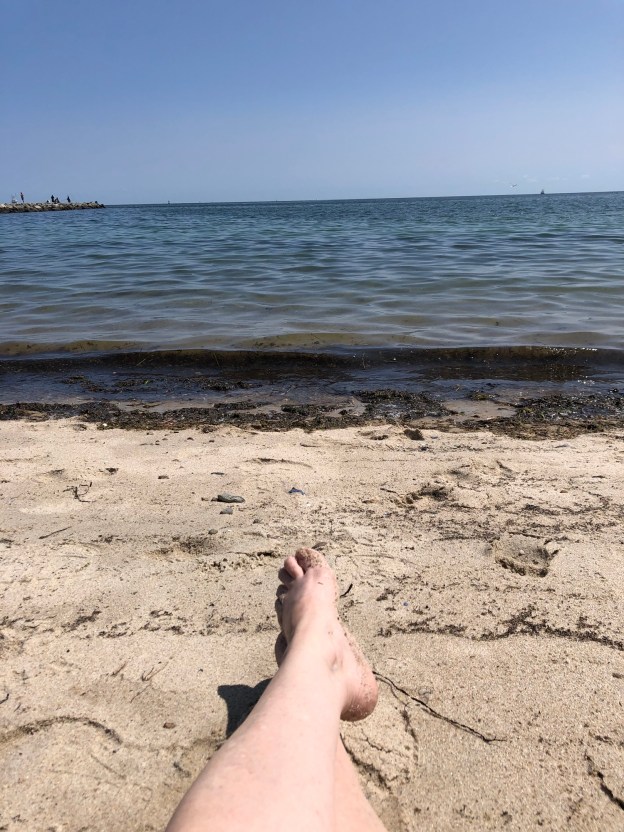
After months of trial, we got to the beach!

….walked two miles this weekend and got to the beach. She could not stay but look how close she got to the water!

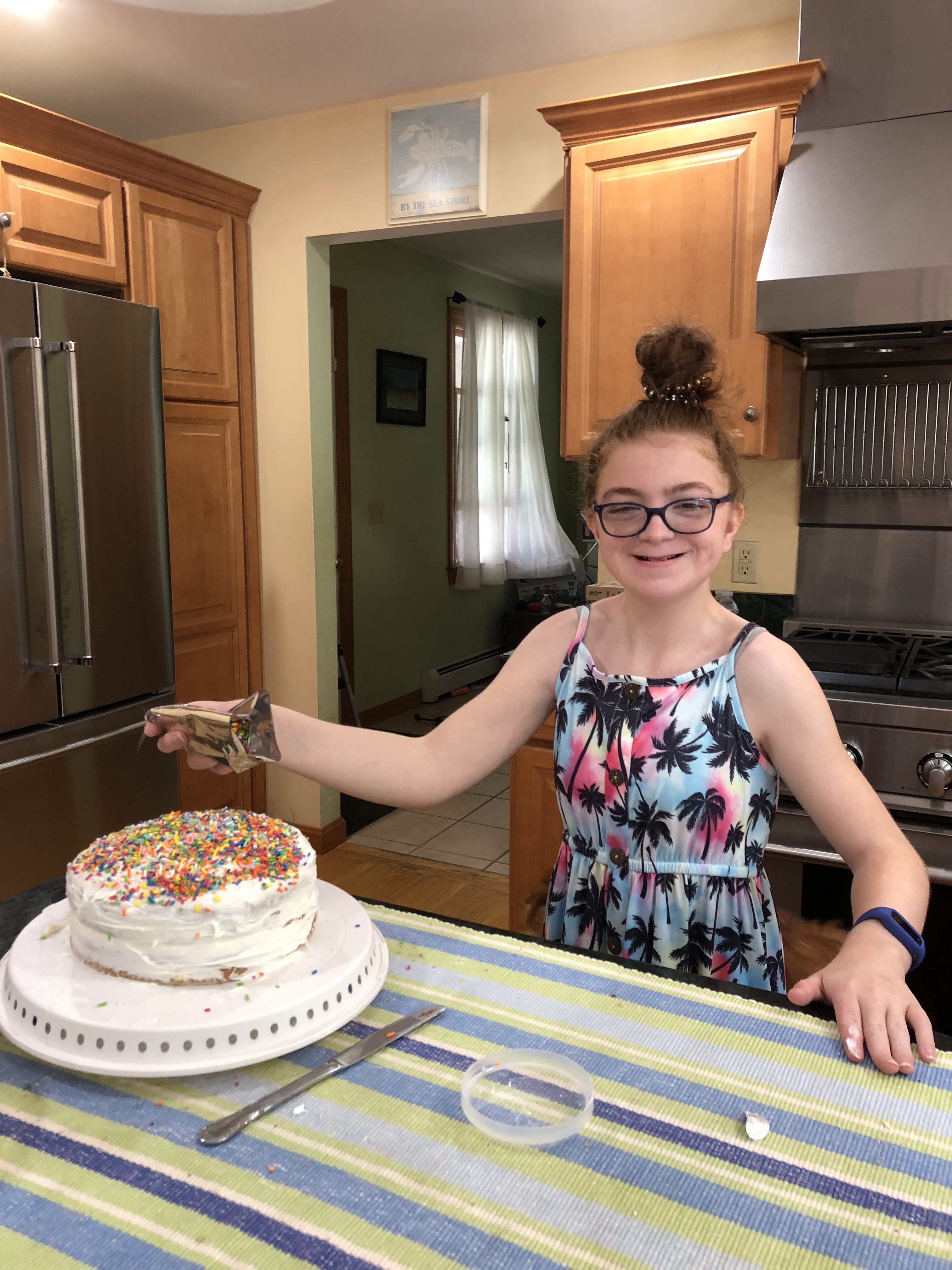
Then to make life a little sweeter, our girl managed to go to the grocery store (another win this month) and made the cake that she had purchased.

Everything is better with cake

And that, my friends, is how I keep the light in our lives. How as hard as this life can be; by celebrating these little wins, it makes the battles easier to fight.

My advice is to keep enjoying those little moments in your life, my fellow warrior parents. Celebrate them. Because if you do, I swear it will make the moments when you are in your driveway screaming at the trees how pissed off you are at this unfair life you’ve been given happen a little less often.

And for the times that you need more than good memories, I recommend calling a really good friend and sharing a glass of the adult beverage of your choice as they listen to how much you love your child but kind of wish there was a warranty given in the delivery room.

Dear Bridget

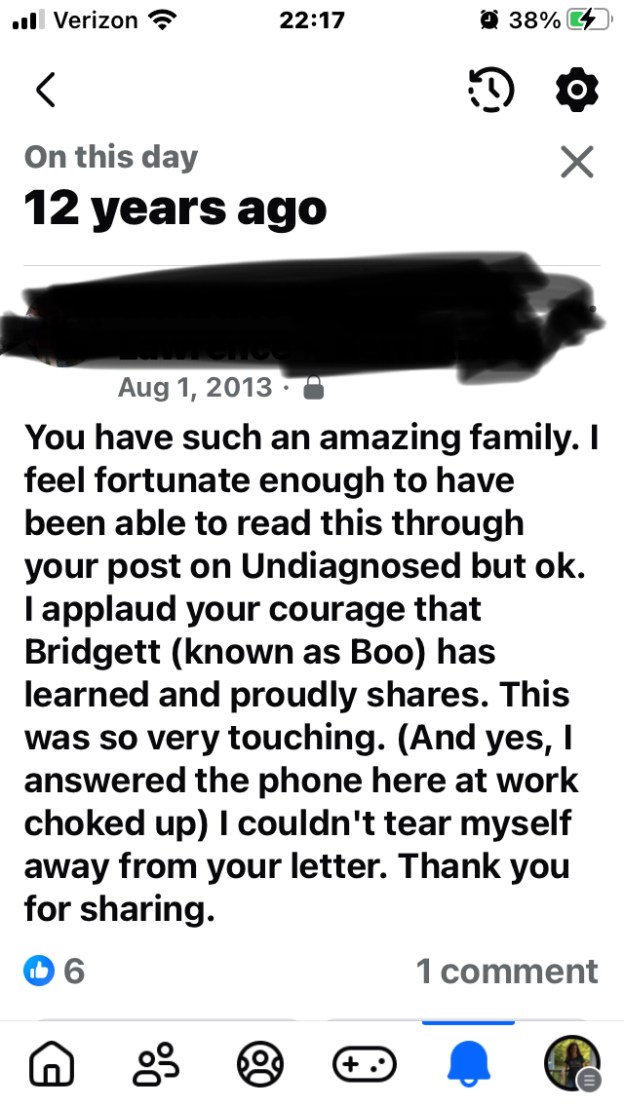
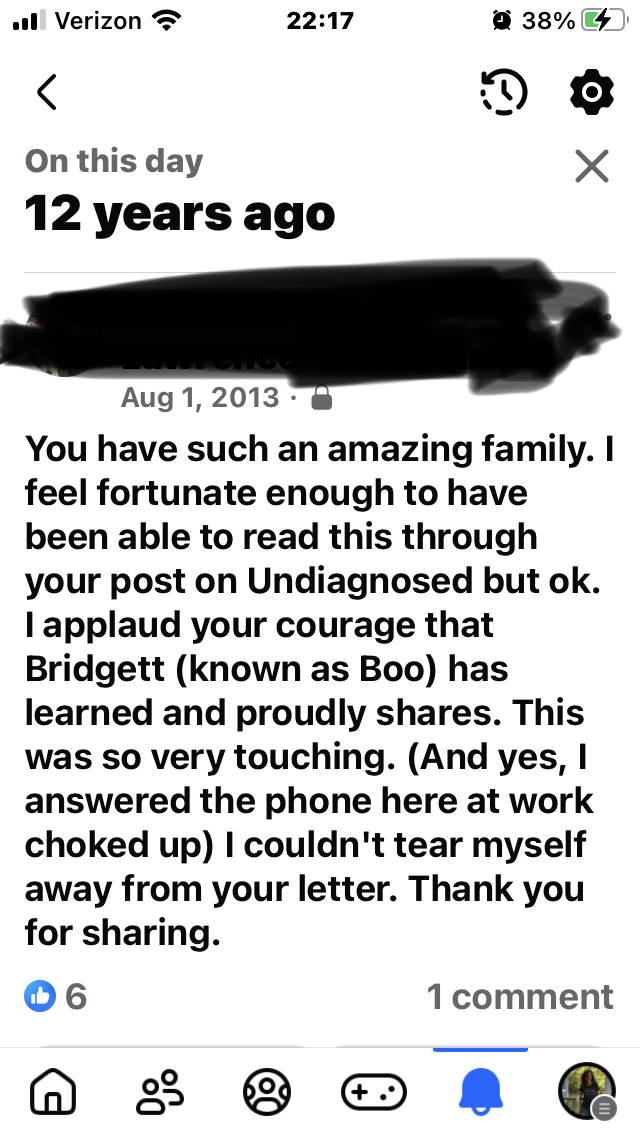
Last week this memory popped up on my Facebook feed and I had no idea what I had written way back in 2013.

I searched and found this post where I was trying to explain to a four-year-old Bridget (Boo back then) why she had to work so hard to make the tiniest progress and how sorry I was that I am the one that causes her the pain, procedures and therapies. Yet I never once in those four years, have I regretted one moment of this unexpected life.

Unfortunately, for Bridget, turning 16 was not sweet. It has been nine months of struggle and after a lot of work, acquiring not one but four more diagnoses and adding more doctors to her list of specialists.

Which brings me to this moment, where that letter to Bridget needs to be updated. *Tissue warning ahead.

Continue reading

Rare Disease Day 2025

I tried to explain to someone recently that having a rare child is both the same yet uniquely different than having a typical child

The typical mom and the rare mom cannot believe their girl is 16 years old

The typical mom is afraid of her 16yo daughter getting her license and discovering boys

The rare mom mourns just a bit that her child will never drive and breathes a sigh of relief that her daughter won’t be in a car with a 16yo boy 🤣

Both the typical mom and rare mom of a 16y daughter watches #gaurdiansofthegalaxy together and sing along to the music. Both the typical and rare 16y daughter tells their moms they have horrible singing and please stop

The typical mom of a 16y daughter worries about her breaking curfew. The rare mom of a 16y puts her to bed at 8p and relaxes with a nice glass of Pinot Grigio

Both moms worry about the future. Both moms worry if their 16y daughter will ever be independent and live on her own

The typical daughter will. The rare daughter will not

Both moms are amazed about what their daughters have accomplished and worry about moments in life where they might fail

The typical mom of a 16y is helping her make plans for after high school. The rare mom is figuring out her life on how to support the 16y that will soon lose the support system of the public schools

Both the typical mom and the rare mom lose sleep at night and worry about their 16y daughters future

Both moms are so in love with their 16y daughters

Both moms need their villagers

And yes, this rare mom gets overwhelmed and sometimes is envious of that typical mom that will experience all those firsts with their typical 16y

This rare mom also knows that this unique child she has been given fills her world with such joy, moments of fantastic and laugh out loud experiences that while this isn’t the life she imagined 16 years ago…she also cannot imagine her world without her rare girl

Which is how I know that both the rare mom and that typical mom parenting isn’t all that different

Experience Makes These Moments Easier

When Bridget had her bilateral ankle surgery, I realized I still maintained my OG of CHB skills. Experience really does make this unexpected life easier to navigate. As I looked around the hospital I began to see the first timers versus those of us who have been around awhile.

Continue reading

Once again, Bridget teaches me

Part of my decision to do the Achilles Tendon Lengthening surgery was the fear that if I didn’t do the surgery now it would mean Bridget would not walk later. I was worried about the post-op, the recovery but that did not weigh as much as what happens if because of toe-walking Bridget becomes wheelchair bound?

Continue reading

When I don’t ask the right questions

I have not always made the best choices for Bridget. I do not always listen to the experts. It’s not that I do not value their opinion. They are knowledgable but they don’t live this unexpected life. Sometimes I am proven correct, and others….

Well I have to admit when I should have asked better questions.

Continue reading

Out of all the therapies…

Throughout her life, Bridget has been exposed to just about every type of therapy designed by the medical professionals.

Speech therapy is probably one of the most frustrating for families. Unlike ABA, PT or OT, Speech therapy takes years to see any progress. With the others there are goals that have mini-steps, so while they do take time to see progress the patient and caregiver get mini-wins along the way.

Continue reading